
By Kimberly Maisonet Gonzalez and Christa von Hillebrandt-Andrade, NOAA International Tsunami Information Center Caribbean Office
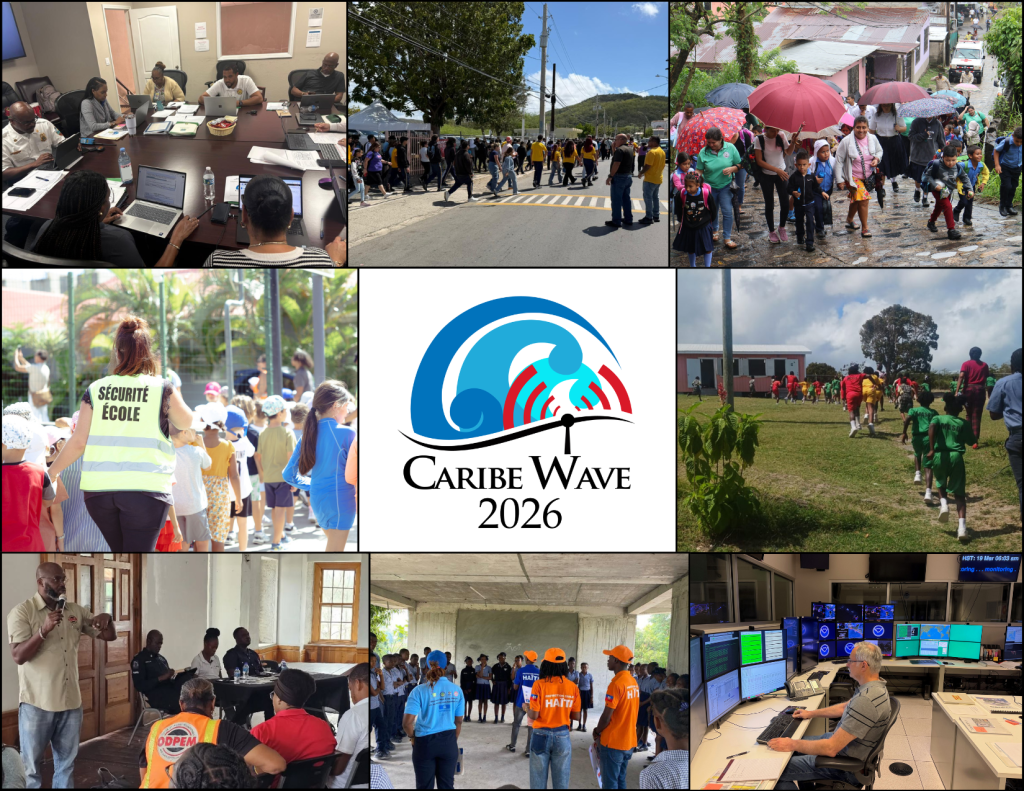
CARIBE WAVE 26 was held on March 19, 2026. This is an annual tsunami exercise conducted to support tsunami preparedness efforts throughout the Caribbean and adjacent regions. Communication tests and the evaluation of tsunami procedures are organized in order to protect lives and livelihoods from tsunami hazards. Over 600,000 people from 43 countries and territories including Puerto Rico and the Virgin Islands, registered on TsunamiZone.org.
The exercise is one of the main activities of the UNESCO/IOC Intergovernmental Coordination Group for the Tsunami and other Coastal Hazards Warning System for the Caribbean and Adjacent Regions (ICG/CARIBE EWS). It is also supported domestically through the US National Tsunami Hazard Mitigation Program (NTHMP). It is coordinated by the CARIBE WAVE Task Team with the support of the NOAA International Tsunami Information Center Caribbean Office (ITIC-CAR), the Caribbean Tsunami Information Center (CTIC), the Pacific Tsunami Warning Center (PTWC), and the Central America Tsunami Advisory Center (CATAC).
This year, each country had the choice between two hypothetical tsunami scenarios: one generated by a 7.6 magnitude Cayman earthquake, based on the February 8th, 2025 event, and the other due to a flank collapse of the Kick ‘em Jenny submarine volcano. Starting at 1500 UTC, an initial “dummy” message was sent as a communications test between the PTWC, CATAC and designated Tsunami Warning Focal Points (TWFPs) and National Tsunami Warning Centers (NTWCs) in each of the countries and territories.
After the initial test, the PTWC issued simulated text and then graphical products for both scenarios, and CATAC issued messages for the Cayman Islands scenario to Central American countries in English and Spanish. The simulated products included the relevant seismic and volcanic information, estimated wave arrival time/heights, and potential areas under threat. For the Kick ‘em Jenny scenario, the PTWC issued its tsunami text products to countries and territories based on the “VONUT” (the Volcano Observatory Notice for tsUnami Threat) messages which are developed by the University of the West Indies Seismic Research Centre (UWI-SRC), responsible for monitoring Kick ‘em Jenny. These messages describe the volcano’s activity relevant for tsunami warning decision making. In addition to the international products, 16 simulated information, advisory and cancellation messages were issued for Puerto Rico, USVI and the British Virgin Islands.
CARIBE WAVE is one of the largest tsunami exercises in the world. Over 600,000 people in the Caribbean and Adjacent Regions registered their tsunami activities according to the ‘Tsunami Zone’ website (tsunamizone.org), which is partially funded by NTHMP funds. Of the registered participants, 220,358 people were from Puerto Rico and 21,526 from the US Virgin Islands. The majority of the participants from across the region were from K-12 Schools and Districts, government, and preparedness organizations. Social media platforms were many groups primary source for communicating tsunami awareness, having worldwide reach.
Activities of CARIBE WAVE include contacting and participating in emergency management exercises, and joining a community event. Groups and individuals also conducted their own activities such as leading or attending a tsunami lecture, updating disaster plans and supplies, holding a tabletop exercise to discuss evacuation routes and shelters, or watching a tsunami documentary. Exercise guidelines and other related materials are available on caribewave.org. Planning is already underway for the CARIBE WAVE 27 exercise, including the final selection of the scenarios.
 TSUINFO ALERT
Leave a comment