By Ignacio Sepulveda (San Diego State University), Randall LeVeque (University of Washington), and Amy Williamson (Berkeley Seismological Laboratory)
*Cascadia Coastlines and Peoples Hazards Research Hub
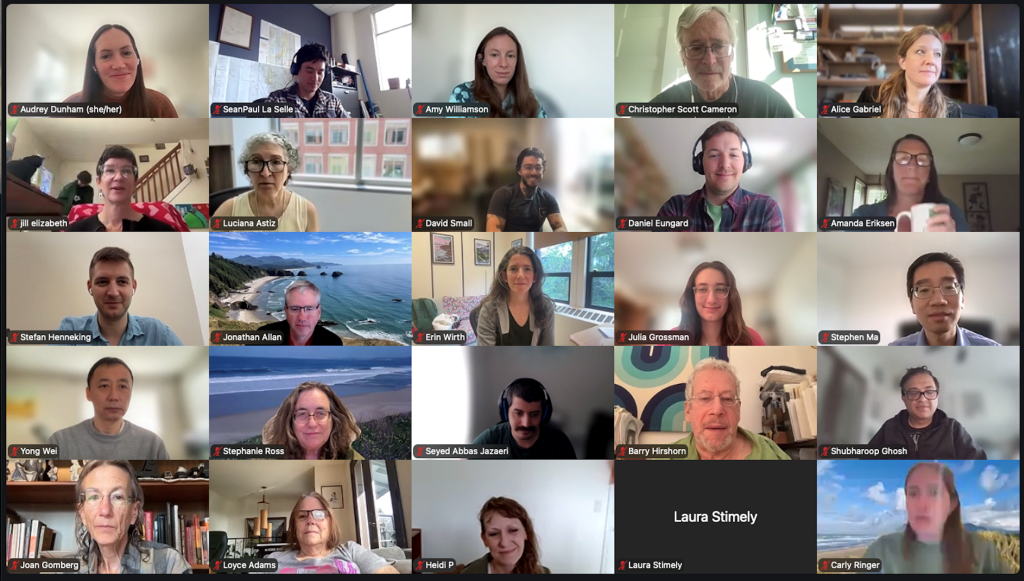
The Tsunami Source for Hazard Assessment (TSHA) Special Interest Group of the CRESCENT Science Center organized the workshop “Using Cascadia CoPes Hub Sources for Tsunami Modeling”. Three sessions took place on September 4th, 11th and 18th, 2026, which allowed participants to learn how to use CoPes tsunami sources (i.e. initial conditions) in their own tsunami model simulations.
The first session on September 4th started with an introduction by Dr. Audrey Dunham (USGS) who provided information on how the sources were generated according to tsunami hazard needs. Dr. Randall LeVeque (University of Washington) provided an explanation on how catalogs and names were organized so access is straightforward. The sessions on September 11th and 18th provided more opportunities for clarifying questions from participants.
The workshop was supported by a benchmark-test that allowed participants to evaluate whether model simulations work as expected. The benchmark-test is implemented in a virtual platform for simplifying comparisons, which includes a landing page with input files and further descriptions. The benchmark-test activity included the simulation of tsunami impacts at Lagoon Creek, Northern California. As described by Carrie Garrison-Laney (Sea Grant/University of Washington), Lagoon Creek is an important site for paleo-tsunami studies that is in need of more tsunami modeling.
Additional links for the workshop: https://cascadiaquakes.org/2026/07/10/tsunami-sources-for-hazard-assessment-virtual-sessions/
CoPes Tsunami Sources: https://depts.washington.edu/ptha/CHTuser/docs/seismic-and-tsunami-sources
More information on the CRESCENT TSHA SIG: https://cascadiaquakes.org/science/tsunami-sources-for-hazard-assessment/