
By Daryl Jaschen, Director, VITEMA
Tsunami Warning Sirens: For the US Virgin Islands Territorial Emergency Management Agency (VITEMA), the goal is simple – maintain forty-four tsunami warning sirens. Our sirens support early warning to a full-time population of 87,146 and an additional 20,000 daily visitors on the islands of St. Croix, St. Thomas, St. John, and Water Island. VITEMA has been the accountable Territorial government agency responsible for sounding the alarm since the first tsunami siren installation in 2011.
Background: It took eight (8) years from 2010 – 2017 to complete the system design, purchase, permitting, installation, and verification of these first line of defense mass messaging sirens, sitting on top of 60-foot-tall wooden poles. The irony of all this effort is, just after the installation of the last twenty sirens, between April to August 2017, two powerful hurricanes in September, 10-days apart, destroyed our system operational capability, due to broken wooden poles (35%) and damaged hardware (85%).
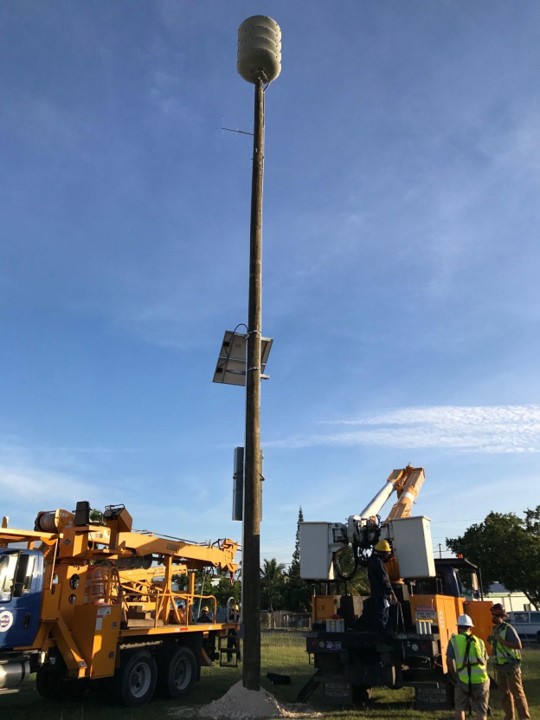
Hurricane Recovery: Thanks to the recovery priorities of the Governor and partnership with the original siren system integrator, a Federal Emergency Management Agency (FEMA) Public Assistance project moved forward with 90% federal and 10% territorial funding, totaling $1.6 million. The project covered not only the re-establishment of all 44 tsunami warning sirens but improved the platform upon which the siren stood.
Instead of using the previously designed wooden poles, the new sirens would rest atop a 60-foot steel poles which had been hot dipped in zinc. This hot-dipped process provides a strong and long-lasting barrier against corrosion. Each steel pole is buried 9 ft below ground and has common ground to prevent damage from a lightning strike. The technology behind each siren consists of an omni-directional high power speaker array (HSPA), two solar panels, a controller module, and two 12-volt batteries (24v dc operating voltage). A computer Secure Digital (SD) memory card contains prerecorded messages accompanying each siren warning tone sequence. In a nutshell, VITEMA chose a system with self-contained electronic controls and regulated battery charging system that ensures full siren operation. Resilience at its finest, or so we thought.
New System Testing: The first new steel pole went into the ground in March of 2021 and the ribbon cutting ceremony, commemorating completion of the 44th pole, occurred in August 2022. After upgrading the control system hardware and software, which had not been damaged but had become outdated, VITEMA began monthly siren tests. These tests were designed to provide the community with confidence in both the functionality and coverage area of the siren and validate the ability of VITEMA to activate the sirens when needed. What proved worrisome was discrepancies with monthly field reports from individuals at a siren site to computer software activation reports. As time moved on, field reports indicated more sirens failing, with some failing due to no tone, some failing with no audio message, or some with both. However, computer software activation reports kept indicating success. VITEMA has no dedicated staff to support its sirens. It also became more difficult to find individuals to provide monthly field reports at all 44 siren sites. At one point, VITEMA was down to a 26% pass rate on monthly testing reports from the field. What became even worse, is that for two months straight, the radio antenna failed to send the signal to any sirens.
System Refresh Lessons: VITEMA contacted the original system integrator, first in 2024 and again in 2026 for assistance. In both instances and is the case for an island, equipment and personnel from off-island had to be mobilized, shipped, and a viable work schedule developed. The island of St. Croix became the focus in 2024 for two weeks, and the vast majority of the 17 siren sites were “refreshed”. In 2026, a second refresh began, covering all 44-sirens, occurring over a period of six weeks. The main lesson learned over the past four years is that the batteries have a much shorter life span, even though they have a solar panel charger connected. Additionally, the harsh salt air, even the Saharan dust impact, does result in component failure occurring more frequently than other environments.
Recommendations: It is important to remember that most islands and coastlines with tsunami warning systems exist in very harsh conditions.
- Plan and budget for frequent refresh windows, with trusted and reliable vendors.
- Include radio communications failures as part of the trouble shooting in these harsh conditions.
- Build a foundation on data and reporting tools which you can trust.
- Outreach to individuals and businesses who are located near siren sights, as they want to and will support in field reports on test day.
- Train individuals in how, when, and on what to report; keep it simple.
- Have a primary and back-up individual for each location.
- Use your public information officer to communicate testing and repair dates. Send out mass mail messages, Facebook posts, and radio public service announcements to keep the public and visitors informed.
Suggested citation: Jaschen, Daryl, August 2026, US Virgin Islands “Refreshes” Forty-Four Tsunami Warning Sirens: TsuInfo Alert. https://tsuinfoalert.blog/2026/09/10/usvi-refreshes-tsunami-sirens/ (accessed MM/DD/YYYY)
 HOME
HOME 