By Danté DiSabatino, Washington State Emergency Management Division
For many communities along Washington’s coast, surviving a major Cascadia Subduction Zone tsunami will depend on whether people can reach high ground in time.
In 2025, the Washington Emergency Management Division (WA EMD) completed the state’s most comprehensive tsunami loss estimate study to date. The study found that a magnitude 9.0 Cascadia Subduction Zone tsunami could result in an estimated 50,000–65,000+ casualties within the first hour from the tsunami alone, representing approximately 29–37% of the population at risk in Washington’s tsunami inundation zone.
The potential impacts are especially severe in low-lying coastal communities where natural high ground may be too far away to reach before the first waves arrive. The 2025 study estimates more than 21,000 potential casualties in Ocean Shores (nearly 100% of the modeled population), approximately 8,700 in Long Beach, and more than 6,000 in Westport.
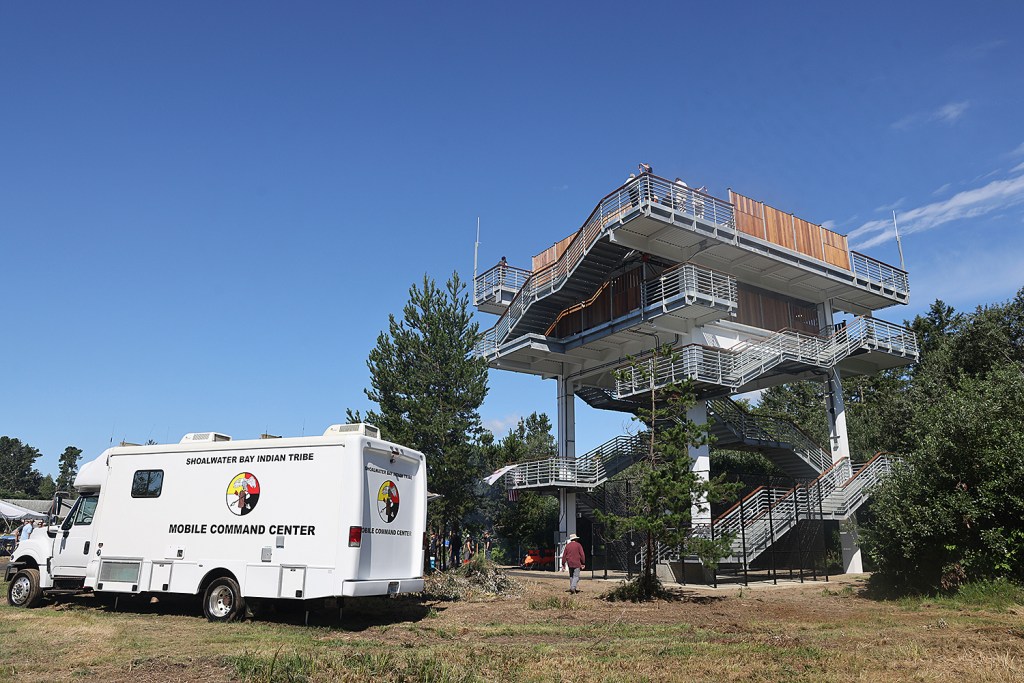
These estimates underscore why tsunami vertical evacuation structures (VES) are a critical life-safety investment for Washington’s coast.
This year, WA EMD’s Tsunami Program worked alongside the cities of Long Beach, Ocean Shores, and Westport to submit five VES applications through FEMA’s Fiscal Year 2024–2025 Building Resilient Infrastructure and Communities (BRIC) grant cycle: one design-and-construction application, one construction application, and three scoping applications for future VES sites.
The three scoping applications for Long Beach, Ocean Shores, and Westport would fund preliminary work needed to develop strong future design-and-construction applications. While the scope varies by community, activities may include geotechnical investigations, preliminary design, cost estimation, and tsunami modeling.
This early work helps answer some of the most important and potentially costly questions as a project advances. Geotechnical investigations, for example, evaluate whether a site is viable and provide critical information about subsurface conditions and foundation requirements, which are often among the most technically complex and expensive components of a VES. Preliminary design allows engineers, community leaders, city staff, and tsunami subject matter experts to evaluate design alternatives, incorporate tsunami-specific requirements, and develop more reliable construction cost estimates.
The goal is to reduce uncertainty early and give communities the technical information they need to develop competitive future applications for full design and construction funding, including the Benefit-Cost Analysis needed to demonstrate a project’s potential life-safety benefits.
At the same time, two communities are seeking funding to move VES projects closer to becoming a reality. The City of Long Beach submitted an application to design and construct its first VES with completed preliminary work, while the City of Ocean Shores submitted an application to construct its first city-owned VES, building on a previous FEMA Pre-Disaster Mitigation 2018 grant that funded the project through approximately 95% design.
For Ocean Shores, the application also marked an important local milestone: the Ocean Shores City Council unanimously approved the City’s share of the required non-federal match, demonstrating the community’s commitment to advancing the project toward construction.
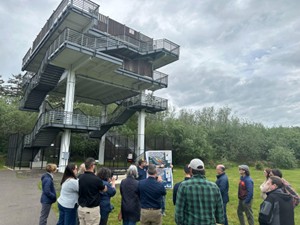
Washington currently has only two completed tsunami vertical evacuation structures: Ocosta Elementary School and the Shoalwater Bay Tribe’s “Auntie Lee” Tower. Washington needs an estimated 58 VES to save the majority of the population in the inundation zone from a major Cascadia Subduction Zone Tsunami.
Closing that gap will take time. Developing additional VES requires years of planning, engineering, funding, community engagement, and coordination among local, state, federal, and technical partners.
Throughout these projects, WA EMD’s Tsunami Vertical Evacuation Structure Project Manager will work closely with Long Beach, Ocean Shores, and Westport, providing project management support, technical guidance, and tsunami subject matter expertise as communities move their projects from early concepts toward design and, ultimately, construction.
Together, these five applications represent different stages of the same long-term effort to save lives: where there isn’t natural high ground, we must build it.
Suggested citation: DiSabatino, Danté, August 2026, From Tsunami Risk to Action: Washington Submits Five Vertical Evacuation BRIC Grant Applications: TsuInfo Alert. https://tsuinfoalert.blog/ (accessed MM/DD/YYYY)