Project Leads: Bridget Good & Mike Crop (OEM), Jonathan Allan & Laura Gabel (DOGAMI)
Executive Summary
Residents and visitors in Oregon coastal communities will have less than 20 minutes from the time ground shaking starts after a Cascadia Subduction Zone (CSZ) earthquake to evacuate from tsunami-hazard zones—often not enough time to reach natural high ground in many areas. For these communities, survival depends not on whether people evacuate, but where evacuation is possible at all.
The CSZ is a 600-mile megathrust fault located 30 to 60 miles offshore the Oregon coast, where the Juan de Fuca plate subducts beneath the North American plate. A CSZ megathrust earthquake is expected to impact the western side of northern California, Oregon, Washington, and British Columbia—home to nearly 24 million people. Following the quake, tsunami waves—ranging in height from several tens of feet to over 100 feet—could reach the coast in as little as 10 to 20 minutes after the shaking starts, leaving little time for evacuation.
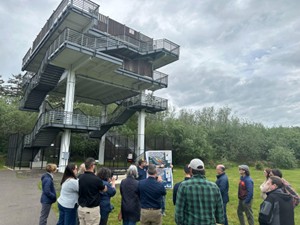
This report outlines the science, risks, and life-saving countermeasures associated with such an event, with a primary focus on the role of Vertical Evacuation Structures (VES) in tsunami-prone areas of Oregon coastal communities. VES are engineered facilities designed to provide safe refuge above anticipated tsunami inundation levels when natural high ground is too far or inaccessible within the short evacuation window.
Tsunamis are not single waves but arrive as multiple surges, often lasting 10–12 hours, but can
last longer. Due to their destructive forces and the mobilized debris, survival rates for
individuals caught by the tsunami are typically less than 1%. Timely evacuation is critical.
Residents and visitors located within the tsunami inundation zone may not survive if they delay
evacuating, are located far from high ground, or experience injuries during the earthquake that
prevent timely evacuation.
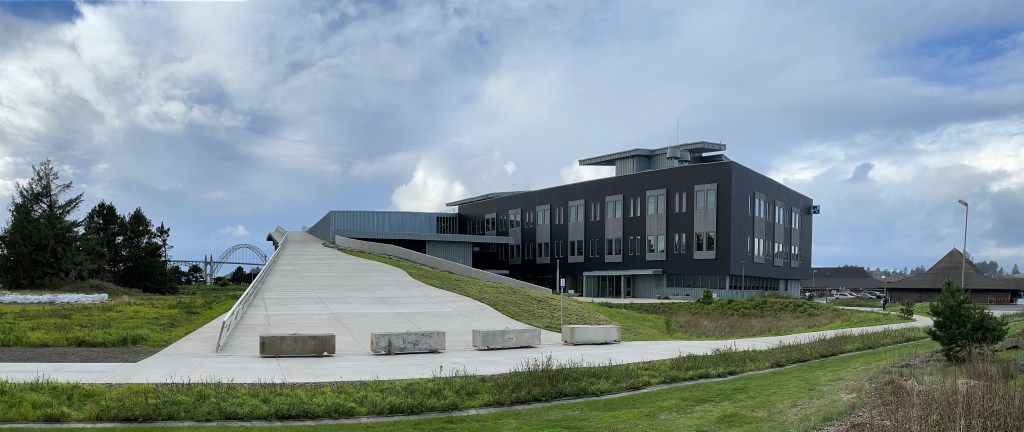
Evacuation modeling undertaken by the Oregon Department of Geology and Mineral Industries
demonstrates that even with no departure delays, the distance that residents and visitors in
some coastal communities must travel to reach high ground may be too far to reach before the
first tsunami surge arrives. For these communities, high ground must be brought closer to the
population centers — a strategy achieved through the implementation of vertical evacuation
structures (VES). Furthermore, it is important to recognize that some communities may require
multiple VES to effectively serve a community and reduce the potential for large loss of life.
Link to full publication: https://www.oregon.gov/oem/Documents/Tsunami_Vertical_Evacuation_Structure_Guidance_2026.pdf
Publication citation: The Oregon Department of Emergency Management, 2026, Tsunami Vertical Evacuation Structure (VES) Guidance: The Oregon Department of Emergency Management, 92 p. https://www.oregon.gov/oem/Documents/Tsunami_Vertical_Evacuation_Structure_Guidance_2026.pdf